Research and Discovery
Before building anything, I audited Malibu's existing social archive across the two prior summer seasons, cataloguing where brand consistency had broken down: which asset types showed the most drift, which color treatments diverged furthest from the core palette, and which content categories generated the highest engagement despite production inconsistency. That last question mattered. High-performing content across both seasons clustered around authenticity signals: real ingredients, real settings, low-production-value moments that felt unscripted. The system I built had to enable that quality, not suppress it in favor of polish.
I then reviewed the brand guidelines in detail and stress-tested them against every asset type the campaign required. The gaps were documented and addressed explicitly in the toolkit before a single production asset was started. A creative system that does not address known gaps is not a creative system. It is a starting point with the problems deferred.
Visual Language System
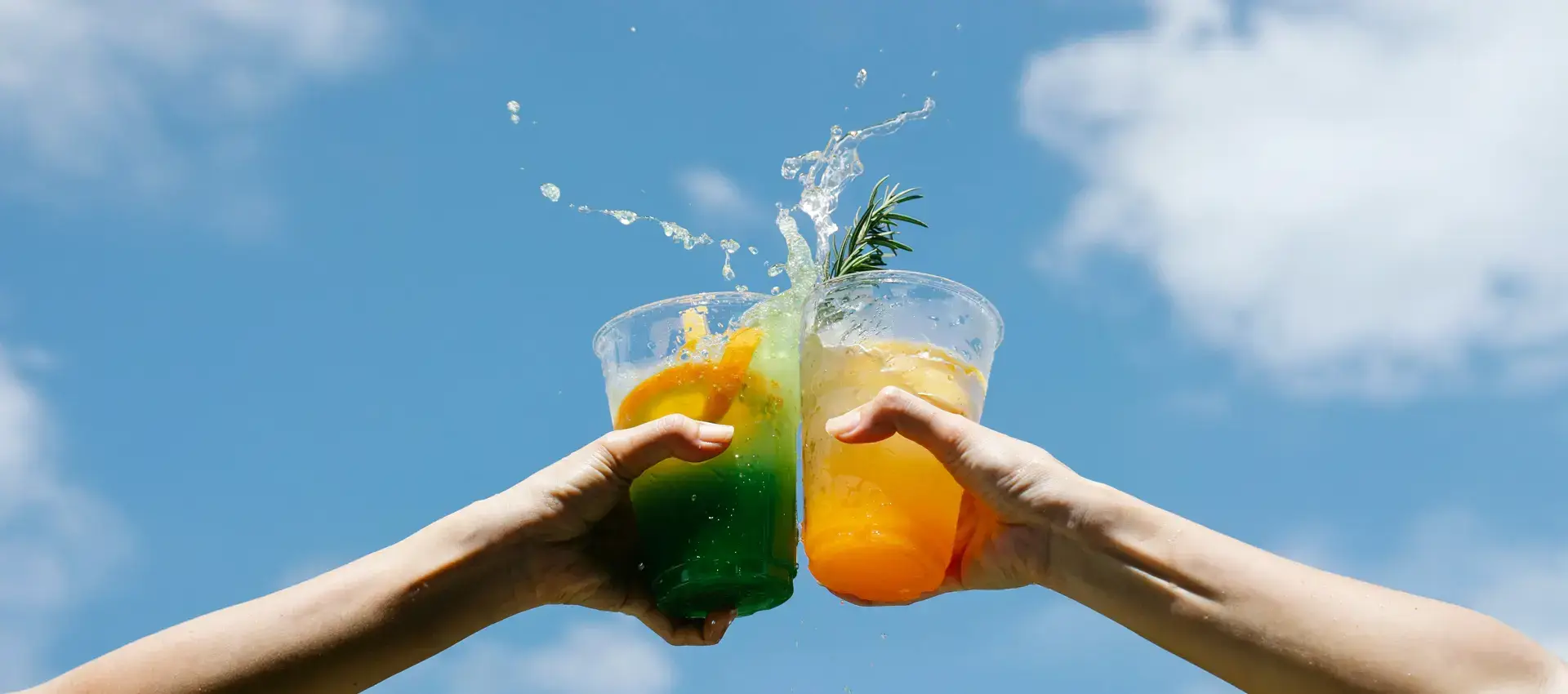
The design language was organized around a single central idea: summer as a physical sensation, not a season. Aqua teals, sun-bleached oranges, and natural textures including woodgrain, lime peel, and grill marks were built into every asset category as foundational surface treatments, not decorative options. Bold hand-painted headline fonts paired with rounded sans-serif body copy kept the tone warm and unhurried. The compositing approach used layered photography and vector overlays in Photoshop to simulate handcrafted quality at production speed, which was the specific balance the campaign volume required.
The visual language also established rules the existing guidelines had not. Dark background treatments for nighttime and event content. Motion principles for animated overlays that maintained the static visual language without requiring the animation team to re-interpret the brand for each format. Co-branding hierarchy documentation for the Snapchat and live activation moments. These additions were not refinements. They were structural requirements for the campaign to stay coherent.
Toolkit Architecture
I delivered over 200 branded elements: logos, stickers, icons, typographic treatments, template layouts, and composited background assets. All delivered as layered PSDs and vector files that animation and content teams could open and produce from directly. Export templates covered 16:9, 1:1, and 9:16 aspect ratios with integrated grid systems for both static and carousel posts.
The benchmark I set for the toolkit: a designer with no prior exposure to the campaign should be able to pick up the assets and produce on-brand content within 30 minutes. That standard shaped every decision about how the files were organized, labeled, and documented. Toolkits that require institutional knowledge to use correctly are not toolkits. They are files.
Campaign Execution and Quality Review
Over 101 consecutive days I worked closely with the motion team on storyboard-to-final-cut consistency and coordinated with content strategists on the release schedule. Quality review was a daily function, not a periodic check. The Bean Cam live-stream overlays and the #Shellfies Snapchat lens integration were the most technically complex deliverables in the campaign. Both required format-specific production approaches that had no direct precedent in the existing toolkit. Both maintained full brand consistency with the static asset library, which is a more meaningful measure of success than the individual deliverables themselves.